Best Lighting for Outdoor Security at Home
By All Phase Electrical QLD · Published · Updated
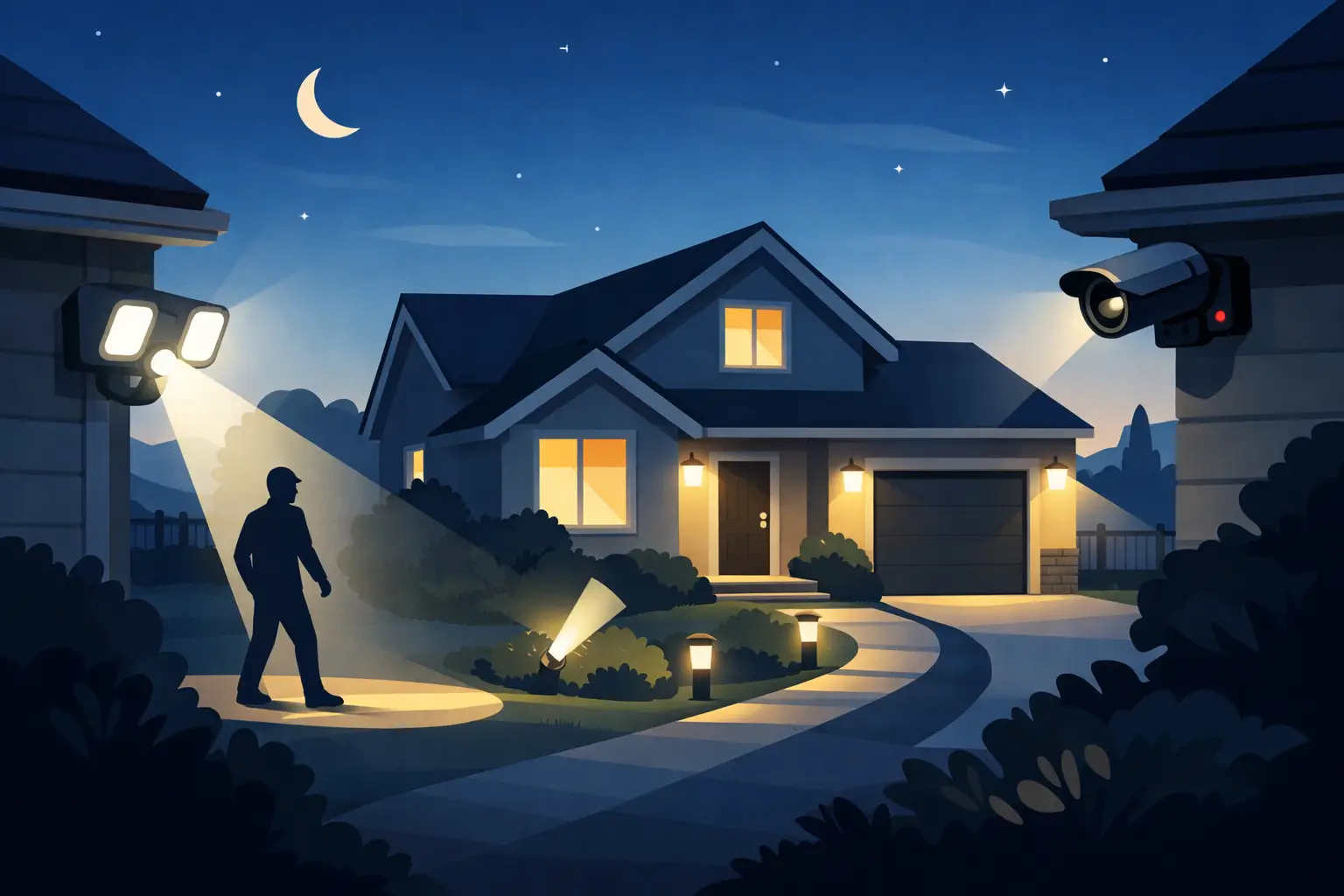
A dark side gate, rear patio or commercial loading area gives intruders cover and makes routine access less safe for everyone else. The best lighting for outdoor security is not simply the brightest fitting available. It is a planned combination of useful light levels, correct positioning, reliable controls and professionally installed equipment that suits the property.
For homes, rental properties and businesses across Ormeau, the Gold Coast and Logan, outdoor security lighting should help people see who is approaching, safely use paths and entrances, and make vulnerable areas less attractive to trespassers. It also needs to stand up to Queensland heat, heavy rain and coastal conditions where applicable.
What makes outdoor security lighting effective?
Effective security lighting removes hiding places without creating new problems. A poorly aimed floodlight can shine into a neighbour's bedroom, reflect off glass, create deep shadows or cause glare that makes it harder to identify a person on camera. More wattage is not automatically better.
The practical goal is even, controlled illumination around access points and areas where someone could move unnoticed. That usually means prioritising front doors, side gates, driveways, carports, rear entries, sheds, bins, common walkways and commercial service areas. Lighting should support, not replace, secure locks, fencing, alarms and CCTV.
LED fittings are the standard choice for most new installations. They use less energy than older halogen systems, provide instant light and generally require less maintenance. Quality matters, particularly for fittings exposed to sun and weather. A low-cost fitting that fails after one wet season can become an ongoing inconvenience and an avoidable electrical cost.
The best lighting for outdoor security by area
Different parts of a property need different types of light. A single floodlight above the garage may brighten a large area, but it is unlikely to properly cover the side of the house or rear gate.
Entrances and front doors
Wall-mounted lights at the front entrance provide clear, welcoming light for residents, visitors and deliveries. They also allow occupants to see faces before opening the door. Choose a fitting that illuminates the approach and doorstep rather than placing a harsh light directly behind a visitor.
For a residential entry, warm white or neutral white light is often more comfortable than a very cool blue-white light. The fitting should be positioned high enough to reduce tampering while still directing light onto the relevant area.
Driveways, carports and garages
Driveway lighting needs enough spread to cover vehicles, pedestrian movement and garage access. LED floodlights or wide-beam wall lights work well when aimed downwards and across the driveway rather than outward towards the street.
A sensor is useful here, especially when arriving home after dark. For properties with CCTV, consider the camera angle before selecting the light position. Good light can improve usable footage, while glare into the lens can do the opposite.
Side paths, gates and rear yards
Side access is often overlooked, yet it can be one of the least visible parts of a home. A compact sensor light at a gate, combined with low-level path lighting where needed, makes the area safer to use and harder to approach unnoticed.
Rear yards vary widely. A small courtyard may only need a wall-mounted sensor light near the back door. A larger block may require separate zones for the patio, shed, pool equipment and boundary access. Dividing the area into zones gives better coverage and avoids flooding the entire yard with light every night.
Commercial premises and shared properties
Businesses, unit complexes and managed sites should focus on access control and safe movement after hours. Entrances, staff parking, rear service doors, loading areas, rubbish enclosures and walkways all need considered coverage.
For these properties, dusk-to-dawn lighting is often appropriate in key areas, with sensor-activated fittings added at secondary access points. Timers and photocells can reduce unnecessary running hours while keeping essential paths visible. The right approach depends on trading hours, site activity, camera coverage and nearby residents.
Sensor lights, timers or dusk-to-dawn controls?
The control method can make as much difference as the fitting itself. Motion sensors are efficient and alert occupants to movement, but they need correct adjustment. A sensor that triggers every time a possum crosses the yard soon becomes background noise. One set too narrowly may miss someone approaching from the side.
Position sensors to detect movement across their field of view rather than straight towards them where possible. Detection range, sensitivity and time-on settings should be adjusted after installation. This is particularly important around streets, footpaths and neighbouring driveways, where unwanted activation can be frustrating.
Dusk-to-dawn controls switch lights on when daylight fades and off at sunrise. They suit front entries, common areas and commercial pathways that need consistent visibility. Timers offer more control where a property only needs lighting during set evening hours.
A combined approach is often the best option: low-level lighting at key entrances from dusk, with brighter sensor-controlled lighting at gates, driveways or secluded areas. This provides useful visibility without keeping high-output floodlights on all night.
Brightness, colour temperature and beam direction
When choosing brightness, look beyond marketing terms. Lumens measure the amount of light produced and are more useful than comparing watts. A small entry light may need only modest output, while a driveway or commercial service area needs broader, brighter coverage.
Colour temperature also affects how the space feels and how well details can be seen. Around 3000K gives a warmer appearance suited to residential entries and outdoor living spaces. Neutral white around 4000K is a common choice for security areas because it provides clearer visibility without appearing excessively harsh. Very cool light can work in some commercial settings, but it may be uncomfortable around homes and can create more glare.
Beam direction is critical. Aim security fittings downwards towards the area that needs illumination. Avoid pointing lights at roads, neighbouring properties or directly into security cameras. Shielded fittings and careful mounting reduce spill light while putting light where it has a practical purpose.
Weather rating and electrical safety matter
Outdoor lighting is exposed to rain, dust, insects, heat and physical damage. Fittings need an appropriate IP rating for the location, particularly where they are fully exposed to weather or installed near pools, garden irrigation or coastal air.
It is also worth considering the mounting surface and cable route. Exterior walls, eaves, fences and outbuildings each present different installation requirements. Wiring must be protected, connections must be suitable for outdoor use, and the circuit should be assessed to ensure it is safe and compliant.
In Queensland, electrical installation work must be completed by a licensed electrician. This is not a DIY job involving a new hardwired circuit, replacement of fixed wiring or changes to switchboard protection. A licensed electrician can recommend fitting locations, install compliant cabling and controls, test the work, and identify whether older circuits or switchboard components need attention.
Solar sensor lights can be useful for a remote gate, letterbox or temporary lighting need where running a cable is impractical. However, their performance depends on solar exposure, battery condition and weather. They are rarely the best primary security solution for a heavily used entry or a business site that needs dependable illumination every night.
Common mistakes to avoid
Security lighting works best when it is designed around how the property is actually used. Installing one powerful fitting over the garage and assuming the whole exterior is covered is a common mistake. So is relying on light alone where broken locks, poor fencing or unmonitored access points remain unresolved.
Avoid placing bright fittings where they create glare for drivers or neighbours. Do not install a sensor without allowing for trees, pets, passing traffic and wildlife. And do not wait until a fitting fails completely before addressing flickering lights, water ingress, damaged cabling or a tripping circuit.
For landlords and property managers, planned maintenance is especially valuable. Check sensor operation, clean lenses, trim vegetation that blocks light, and replace damaged fittings before a tenant or visitor is left navigating a dark accessway.
A practical lighting plan for your property
Start by walking around the property after dark. Identify where you cannot clearly see a person, safely use a path, find a lock or view a camera image. Then consider which areas need constant light and which only need illumination when movement occurs.
A qualified electrician can turn that assessment into a practical layout that balances coverage, energy use, appearance and compliance. All Phase Electrical can assist with outdoor security lighting as part of a broader electrical and CCTV solution for homes and commercial properties across Ormeau, the Gold Coast and Logan.
The right outdoor lighting should make a property easier to live in, safer to access and less inviting to unwanted visitors - without turning the yard into a glare-filled inconvenience. A well-positioned, professionally installed system delivers that result night after night.