RCD Safety Switch Testing Explained
By All Phase Electrical QLD · Published · Updated
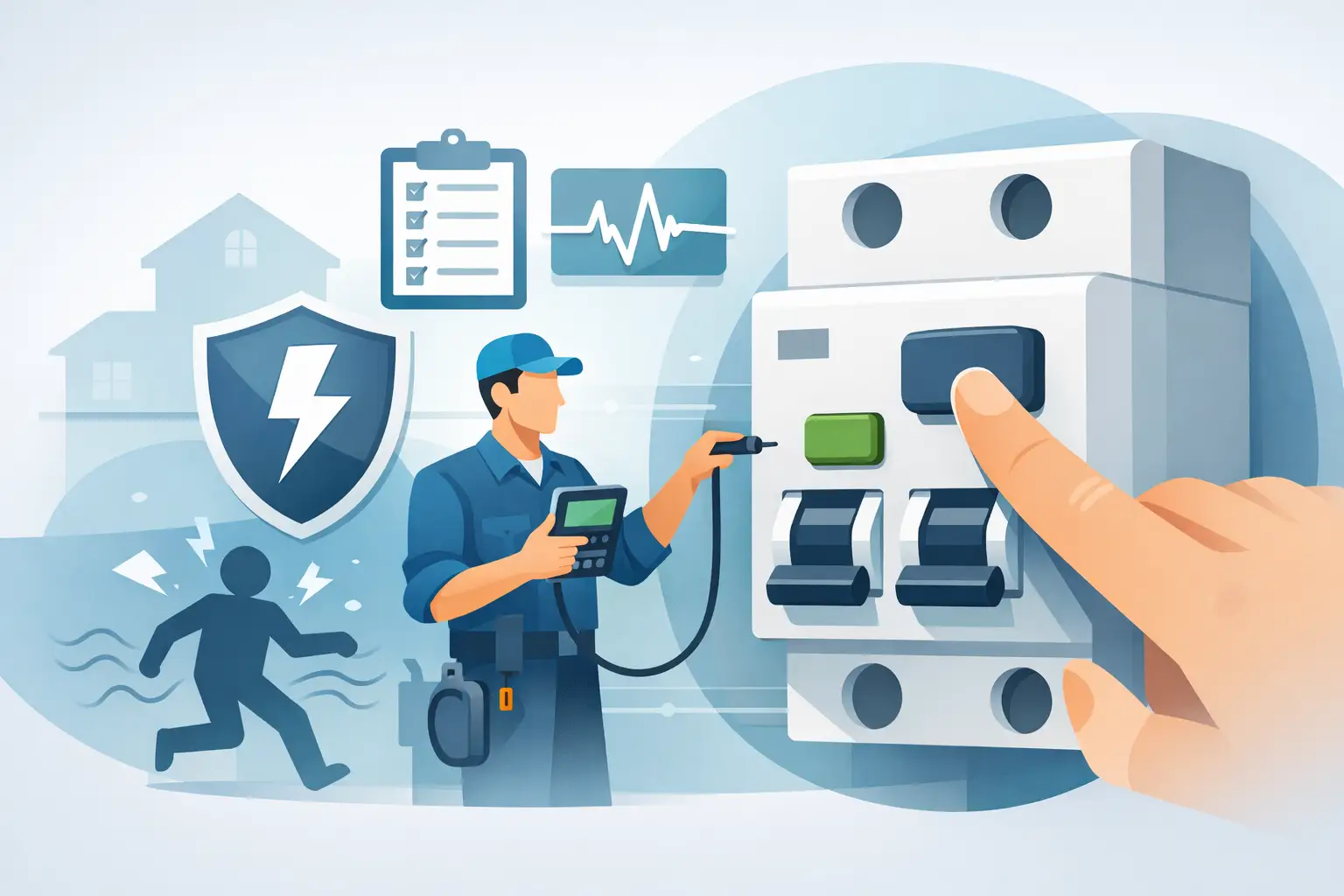
One failed safety switch can sit unnoticed for months, right up until a fault happens and it does not trip when it should. That is why RCD safety switch testing matters. For homes, rentals and commercial sites across Ormeau, the Gold Coast and Logan, it is one of the simplest ways to confirm a critical safety device is still doing its job.
An RCD, or residual current device, is designed to cut power fast when it detects current leakage. In plain terms, it helps reduce the risk of electric shock and can also limit damage during certain electrical faults. But like any protective device, it cannot just be installed and forgotten. It needs to be tested at the right intervals and assessed properly if anything seems off.
What RCD safety switch testing actually checks
A safety switch is there to monitor the balance of current flowing through a circuit. If electricity starts escaping to earth, such as through damaged wiring, a faulty appliance or a person, the RCD should trip quickly and disconnect the supply. Testing checks whether that response still happens.
There are two practical parts to this. The first is the built-in test button on the device itself. Pressing that button simulates a fault and should cause the switch to trip. The second is professional testing with specialised equipment, which measures trip times and confirms the device is operating within the required parameters.
That difference matters. A manual button test is a useful routine check, but it does not replace electrical testing by a licensed electrician. If you manage a workplace, rental property or commercial facility, relying on the button alone may leave gaps in compliance and safety.
How often should safety switches be tested?
The answer depends on the property type, how the installation is used, and whether there are workplace obligations to meet.
For households, a regular push-button test is generally recommended every three months. That gives you a basic check that the mechanism still trips. If the button does nothing, the switch does not reset, or power behaves unpredictably afterwards, it needs professional attention.
For commercial premises, the testing schedule is often stricter. Workplaces may require routine inspection and verification under relevant safety procedures, especially where portable equipment, wet areas, outdoor circuits or higher-risk operating conditions are involved. Facility managers and business owners should not assume the domestic testing routine is enough.
Rental properties can also raise extra considerations. Landlords and property managers are responsible for maintaining electrical safety, and a non-functioning safety switch can quickly become a serious issue. If there is any doubt about switchboard age, previous electrical work or tenancy turnover, testing is a sensible step.
Why RCD safety switch testing is not just a box-ticking exercise
It is easy to treat testing as routine compliance, but the reason behind it is straightforward. Safety switches are mechanical and electrical devices. Components can wear out. Internal parts can stick. Dust, age, moisture or previous fault activity can affect performance over time.
A switch may still look fine from the outside while failing to trip fast enough under fault conditions. In some cases, it may not trip at all. That is where proper testing becomes valuable. You are not just confirming the switch exists. You are confirming it responds the way it should when there is a real hazard.
For businesses, this also comes back to duty of care. If your premises are used by staff, contractors, tenants or the public, electrical protection is not an area where guesswork helps. A recorded testing and maintenance approach gives you clearer visibility over risk.
Signs your safety switch may need immediate attention
Sometimes the issue is obvious. The test button does not trip the device, the switch will not reset, or circuits keep dropping out for no clear reason. Other times, the warning signs are more subtle.
Frequent nuisance tripping can point to a faulty appliance, wiring issue, overloaded circuit or deteriorating RCD. It does not always mean the switch itself is defective, but it does mean the circuit needs proper diagnosis. Ignoring repeated trips is risky because it can mask an underlying electrical fault.
Older switchboards are another common factor. If a property has had extensions, air conditioning additions, appliance upgrades or previous patchwork electrical work over the years, protection may not be as consistent as expected. Some circuits may be covered by safety switches while others are not. Testing can reveal those gaps.
If you have moved into an older home, taken over a commercial tenancy, or manage a property with an unclear electrical history, it is worth having the switchboard checked rather than assuming everything is current and compliant.
What happens during professional testing?
A licensed electrician will inspect the switchboard, identify which circuits are protected by RCDs, and carry out instrument testing to verify operation. This includes checking whether the device trips within the required time and whether it resets correctly.
That process can also uncover related problems. Sometimes the RCD is fine, but the circuit has insulation issues, incorrect connections, appliance faults or switchboard defects that are affecting performance. In other cases, the safety switch is outdated or unreliable and should be replaced.
For commercial and multi-use sites, proper labelling and circuit identification are also important. A switchboard that is poorly labelled creates confusion during faults, shutdowns and maintenance. Good testing often goes hand in hand with bringing order back to the board so the installation is safer and easier to manage.
Homes, rentals and businesses all have different risks
In a family home, the priority is usually personal safety. Wet areas, outdoor circuits, pool equipment and general power circuits all benefit from properly functioning RCD protection. Parents with young children, older residents and households using multiple portable appliances have good reason to stay on top of testing.
In rentals, there is the added issue of turnover. Different tenants use properties differently, and wear on circuits and appliances varies. Landlords who leave switchboards unchecked for years can end up dealing with avoidable faults, urgent repairs and safety concerns at the wrong time.
In commercial settings, downtime becomes part of the equation. A tripping issue in a shop, office, warehouse or managed facility can affect operations, staff access, refrigeration, lighting or security systems. Testing is not only about protection from shock. It also helps identify reliability issues before they interrupt business.
When replacement is the better option
Testing does not always end with a clean result. If an RCD is old, unreliable, fails trip-time testing or is part of a switchboard that no longer suits the property, replacement may be the smarter path.
This is especially true where switchboards have been added to over time without a clear upgrade plan. New circuits, air conditioning systems, ovens, hot water services and commercial loads can change the way the electrical installation performs. Sometimes the real issue is not one faulty switch but an outdated board that needs a more complete upgrade.
A qualified electrician can advise whether a simple replacement is enough or whether broader switchboard work should be considered. It depends on the age of the installation, the number of protected circuits, the site use and any signs of heat damage, poor connections or non-compliant work.
Choosing the right electrician for RCD safety switch testing
Because this is safety-critical work, licensing matters. You want a contractor who can test, diagnose and repair the issue properly, not just press a button and move on. For property owners and managers, local response also matters, especially when a tripping fault is affecting power or access.
An electrician with experience across residential and commercial work is often the better fit because they can deal with more than the immediate test result. If the job uncovers switchboard problems, damaged wiring, circuit imbalance or the need for upgraded protection, you need someone equipped to handle the next step without delay.
For customers in Ormeau, the Gold Coast and Logan, that means working with a licensed electrician who understands local property types, common switchboard issues and the practical demands of homes, rentals and business sites. All Phase Electrical handles this type of work with a direct focus on safety, compliance and reliable fault finding.
A safety switch only helps when it trips at the right time. If it has been a while since your last check, or your switchboard is showing signs of trouble, testing now is a far better option than finding out during a fault.
A switchboard fault rarely gives much warning. One moment an appliance is running normally; the next, power is off to part of the property or a safety device has tripped. Understanding the difference in a safety switch versus circuit breaker helps you respond safely, identify when a simple reset may be appropriate, and know when the issue needs a licensed electrician.
Both devices are essential, but they protect against different electrical risks. A circuit breaker protects wiring and equipment from excessive current. A safety switch protects people from electric shock. Modern switchboards commonly contain both, and neither should be treated as a substitute for the other.
Safety switch versus circuit breaker: the key difference
A circuit breaker monitors the amount of electrical current flowing through a circuit. If a circuit is overloaded or develops a short circuit, it trips to stop the wiring from overheating and potentially causing damage or fire.
A safety switch, also known as a residual current device or RCD, monitors whether electricity is flowing where it should. It detects a small imbalance between the active and neutral conductors, which can happen if current is leaking through an appliance, damaged cable, water, or a person. It disconnects power very quickly to reduce the risk of serious electric shock.
Put simply, a circuit breaker is there mainly to protect the electrical installation. A safety switch is there mainly to protect people. Both may trip during a fault, but the cause and level of urgency can be different.
What a circuit breaker does
Every electrical circuit has a safe current limit based on the cable size, the circuit design and the equipment it supplies. A circuit breaker is selected to suit that circuit. For example, lighting, power points, air conditioning and hot water may each have separate breakers.
A breaker can trip for two common reasons. The first is an overload, such as running too many high-demand appliances from one circuit. Portable heaters, kettles, toasters and microwaves can quickly add up on a kitchen or living-area circuit. The second is a short circuit, where active and neutral conductors come into contact or a fault creates a very high current flow.
If a circuit breaker trips once after an obvious overload, reducing the load and resetting it may restore power. If it trips again, do not keep forcing it back on. Repeated tripping can point to a damaged appliance, faulty outlet, deteriorated wiring or another fault that requires testing.
What a safety switch does
Safety switches are designed to act fast when they detect current leaking to earth. This could occur when a damaged extension lead is used outdoors, moisture enters an appliance, insulation breaks down, or a person contacts a live part of the electrical system.
They do not prevent every electrical incident. A safety switch cannot make unsafe behaviour safe, and it may not operate in every possible fault scenario. However, it is one of the most important layers of protection in a home, rental property or commercial premises.
Safety switches usually have a test button marked "T" or "Test". Pressing it should switch the device off, confirming the mechanism can trip. The device can then be reset. Testing should be carried out in line with the manufacturer's instructions and the maintenance requirements for your property. If the test button does not trip the device, arrange for a licensed electrician to inspect it promptly.
Why modern switchboards need both devices
Older switchboards may have ceramic fuses, basic circuit breakers or limited safety-switch protection. While a fuse or breaker can protect cables from overcurrent, it does not provide the same personal shock protection as an RCD.
A modern switchboard upgrade may use individual circuit breakers alongside safety switches, or combined devices called RCBOs. An RCBO provides both overcurrent protection and residual-current protection for a single circuit. This can make fault finding easier and reduce the chance that one appliance fault cuts power to multiple areas of the property.
The best arrangement depends on the age of the installation, the number and type of circuits, how the premises are used and applicable electrical requirements. A home with a pool, outdoor power, air conditioning and solar equipment has different demands from a small office, retail tenancy or investment property.
Safety-switch requirements have changed over time, particularly when circuits are added, altered or upgraded. Rather than assuming an older board meets current expectations, have a licensed electrician assess the switchboard and advise on practical upgrade options.
What it means when a device trips
A tripped device is doing its job, but it should not be ignored. The next step is to determine whether the issue is isolated to an appliance or is part of the fixed wiring.
If a safety switch trips, turn off and unplug appliances on the affected circuit before attempting one reset. If it stays on, reconnect appliances one at a time. If the switch trips after a particular appliance is connected, leave that appliance unplugged and have it repaired or replaced.
If the safety switch will not reset even with appliances unplugged, there may be a fault in fixed wiring, an outdoor circuit, lighting, a hard-wired appliance or moisture-affected equipment. Do not dismantle outlets, remove switchboard covers or attempt your own repairs. Contact a licensed electrician.
For a circuit breaker, consider whether the circuit was heavily loaded. Spreading appliances across suitable circuits may resolve a one-off overload. However, a breaker that trips repeatedly, feels hot, makes buzzing sounds or has visible damage needs professional attention. Burning smells, scorch marks, shocks or flickering power are urgent warning signs.
Common situations that cause confusion
A power point may stop working because the circuit breaker has tripped, while the safety switch remains on. This often suggests an overload or short circuit rather than earth leakage. Conversely, an RCD may trip while the relevant circuit breaker stays on, indicating a possible leakage fault.
Sometimes one main safety switch protects several circuits. When it trips, lights and power points in more than one room may go off together. This is common in older installations and can make it difficult to locate the problem. Individual RCBO protection can provide better separation between circuits where suitable.
Another common misunderstanding is assuming a safety switch protects against a power surge. It does not. Surge protection is a separate consideration and may be worthwhile where sensitive electronics, security systems, appliances or business equipment are exposed to supply disturbances.